How Many Laser Hair Reduction Sessions Are Needed for Permanent Hair Reduction?
Having unwanted hair can be very annoying, most of all when shaving, waxing, or threading is not long-lasting. So if you are tired of having to remove unwanted hair every few days, you may be weighing up whether to have laser hair reduction.
How many sessions laser hair reduction are actually needed? – one of the first questions people ask before we begin treatment?
It depends on the area being treated, the thickness of the hair, the skin type, hormone activity and the laser used. Some people notice a decrease after their first session; others require a series of treatments before they notice a reduction.
Knowing the treatment process before you book the appointment will be better as it helps to keep your expectations realistic and you will know, which treatment plan will be good for you.
Why Does Laser Hair Reduction Require Multiple Sessions?
How laser hair removal work laser hair removal treatment involves aiming high energy light beams at the hair. This light energy heats up the hair (which has picked up the light energy), this way burning the hair follicle and preventing the regrowth of new hair. But it doesn’t all grow at once.
Hair generally moves through three main stages:
Anagen (growth phase): Hair is actively growing, and there is a lot of pigment cells in the follicle. This is the optimal phase for laser therapy.
Catagen (transition phase): Hair stops growing and the follicle starts to regress.
Telogen (resting phase): The hair remains dormant until it falls out and grows anew.
Laser treatments are most effective on hairs that are actively growing. Because hairs within a treated area will all be at different phases of growth at any one time, a single treatment is unlikely to remove all hairs.
That is the reason a doctor will generally suggest a regimen of treatments rather than booking an appointment on the spot.
How Many Laser Hair Reduction Sessions Are Usually Needed?
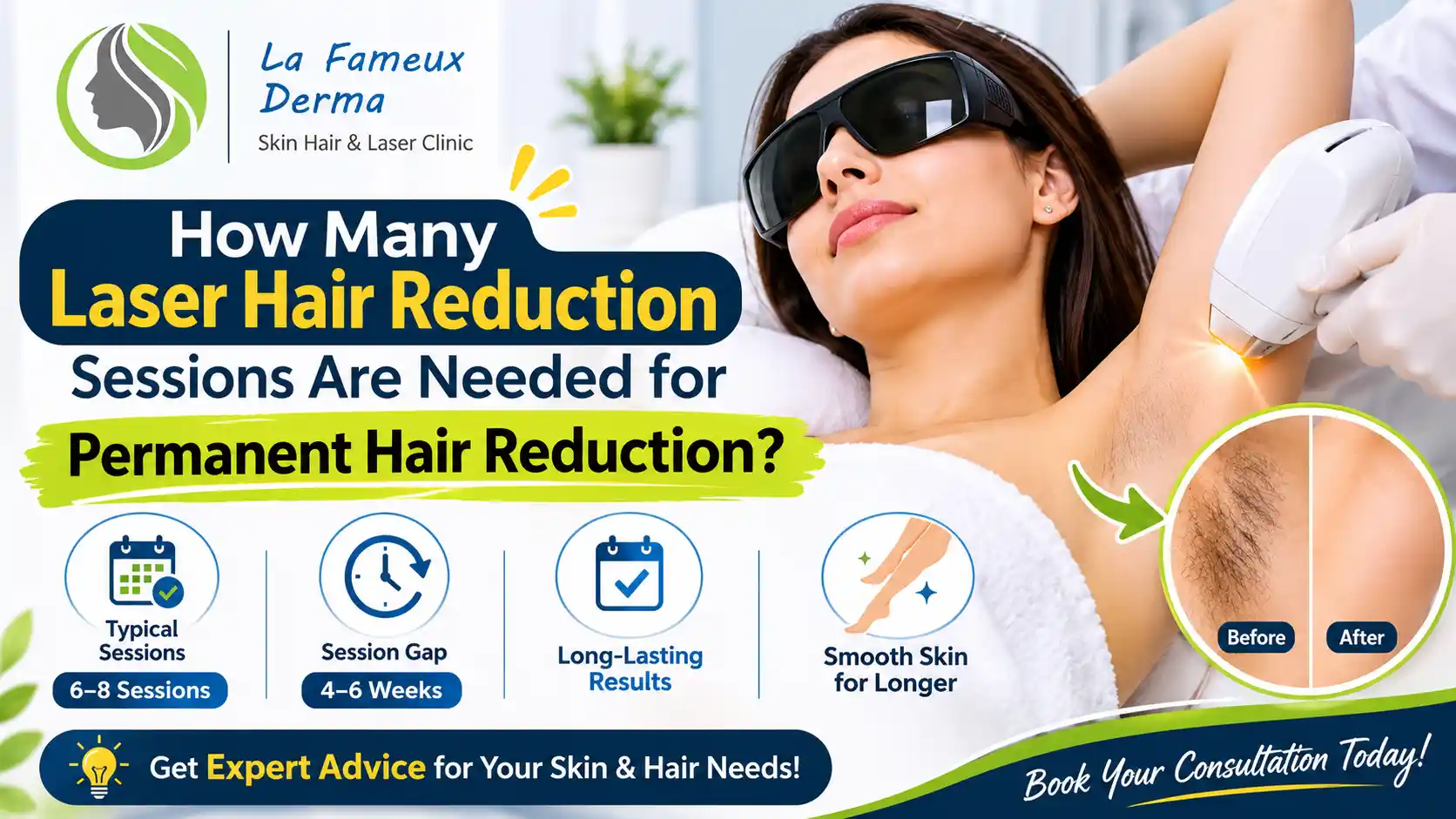
I do not know how many sessions I will need. Most people require six or more sessions to experience a good, long-term reduction in hair.
Some areas may be a lot faster, while others may need to have further classes due to thicker hair, hormonal effects or various growth cycles.
The treatment will have to be based upon a skin and hair examination and not be a package that is offered to everyone.
Laser Hair Reduction Sessions by Body Area
Different body areas have different hair growth patterns. This can affect the number of sessions and the time between appointments.
| Treatment area | What to expect |
| Upper lip | May need regular sessions because facial hair can be influenced by hormones |
| Chin | Coarse or hormonally influenced hair may need additional treatment |
| Underarms | Darker, thicker hair may respond well in suitable candidates |
| Arms | Results depend on hair thickness and density |
| Legs | Larger treatment area, with intervals based on the hair growth cycle |
| Bikini area | Hair thickness and individual growth patterns influence treatment needs |
These are general observations, not guaranteed session counts. Your dermatologist should decide the number and spacing of sessions after assessing the treatment area.
Why Do Some People Need More Laser Hair Reduction Sessions?
Two people can have the same treatment and still have different outcomes. This does not necessarily mean that the treatment has failed. It all comes down to the differences in hair and skin type.
Below are some of the common reasons for requiring extra sessions.
1. Hair Thickness and Colour
Laser devices target pigment in the hair. Darker, coarser hair often responds better because it contains more pigment for the laser to target.
Very light, white, grey or red hair may respond poorly because it contains less suitable pigment.
2. Hormonal Changes
Hormones can influence hair growth, particularly around the chin, upper lip and jawline.
Conditions such as polycystic ovary syndrome (PCOS) may contribute to increased facial or body hair in some women. In these cases, new hair growth may continue even after a series of laser sessions.
A dermatologist may recommend investigating the underlying hormonal cause alongside hair reduction treatment.
3. Skin Type
Skin tone is an important consideration when choosing laser settings and equipment.
Modern laser technology offers treatment options for different skin tones, including darker skin. However, the device and settings must be selected carefully to reduce the risk of burns and unwanted pigmentation changes.
4. Treatment Intervals
Having sessions too close together does not automatically produce faster results.
Hair follicles need time to move through their natural growth cycles. If sessions are not scheduled appropriately, the treatment may not target enough actively growing hairs.
Following the dermatologist’s recommended schedule is important.
5. Type of Laser Used
Different laser systems employ various wavelengths and technologies. The right laser choice will vary given skin tone, hair colour, hair coarseness and the part of the body that is to be treated.
The user’s experience of using the device is important. Settings that are not correctly applied can cause the skin to become irritated, or result in burns or pigmentation changes.
How Long Should You Wait Between Laser Hair Reduction Sessions?
The time gap between sessions is equally as important as the number of sessions.
Most patients are booked four to six weekly for appointments, but this will depend on the area being treated, hair growth cycle and overall result.
For example, facial hair may have a different growth pattern to the hair on your legs or your back. It may be better to follow different schedules for different areas.
Your dermatologist might extend the time between treatments after monitoring how much hair has returned and the response of your skin.
Don’t buy in additional sessions without professional advice because you want your results to come faster.
What Happens If Hair Starts Growing Back After Laser Treatment?
Noticing some hair growth after laser treatment does not always mean that the procedure has failed.
There are several possible explanations:
- Some follicles may not have been in the active growth stage during previous sessions.
- Untreated follicles may become active later.
- Hormonal changes may stimulate new hair growth.
- Some treated follicles may recover partially over time.
In many cases, the regrowing hair becomes finer, lighter or less noticeable than before.
Some people may also require maintenance sessions to manage new growth and maintain their results.
It is important to understand that laser hair reduction offers long-term reduction in unwanted hair, but it does not guarantee completely hair-free skin forever.
Does Laser Hair Reduction Work for Facial Hair?
Yes, laser hair reduction is safe on specific parts of the face such as upper lips, lower lips, chin, and some parts of the jaw.
But facial hair should be examined with more caution, mainly when the growth is related to a hormonal disorder.
This means that for those experiencing chin hairs, the new hair can continue to grow after their first course of treatment.
A hair pattern will be analysed and reasons for losing hair will be discussed, plus the potential results from the treatment. The effects of the treatment will also be explained by a dermatologist before beginning.
Individuals with extremely fine facial hair should also be thoroughly evaluated, as laser treatment may not be applicable to some types of hair.
What Should You Do Before and After Each Session?
Good preparation and aftercare can help reduce avoidable skin irritation.
Before Your Session
- Avoid waxing, threading and plucking for the period recommended by your dermatologist.
- Shave the treatment area if instructed by the clinic.
- Avoid tanning and excessive sun exposure.
- Inform the doctor about medications and any history of skin sensitivity.
- Follow the preparation instructions provided for your particular laser treatment.
After Your Session
- Protect the treated area from direct sunlight.
- Use sunscreen on exposed treated skin as advised.
- Avoid hot showers, intense heat and activities that irritate the skin for the period recommended by your provider.
- Do not scratch or pick at the treated area.
- Follow the clinic’s aftercare instructions.
Mild redness and swelling can occur after treatment and usually settle within a short period. Blisters, burns or persistent skin colour changes should be assessed by a medical professional.
How to Choose the Right Laser Hair Reduction Clinic?
Choosing a clinic should involve more than comparing the cost of individual sessions.
Before starting treatment, consider these points:
Check the medical professional’s experience: Ask who will perform the procedure and whether a qualified doctor supervises the treatment.
Understand the laser technology: Ask which laser is suitable for your skin tone and hair type.
Request an individual assessment: Your treatment plan should consider the area, hair density, skin condition and medical history.
Discuss realistic results: A responsible provider should explain the likely reduction, limitations and possibility of maintenance sessions.
Understand the complete cost: Ask how many sessions may be required, what is included in the package and whether follow-up appointments cost extra.
These questions can help you make a more informed decision instead of choosing a treatment based only on a discount or promotional offer.
When Should You Consider Laser Hair Reduction in Noida?
If you regularly experience unwanted hair on your face, underarms, arms, legs or other suitable body areas, a professional assessment can help you understand whether laser hair reduction is appropriate.
At La Fameux Derma, the treatment approach focuses on assessing individual skin and hair concerns before discussing suitable options.
If you are considering Laser Hair Reduction Treatment, you can explore the procedure and discuss your treatment requirements with the clinic.
A consultation can help you understand the expected number of sessions, suitable treatment intervals, preparation requirements and possible results.
The clinic is located in Noida Sector 50, with additional locations in Vaishali and Shahdara.
Final Thoughts
Laser hair reduction is a treatment process rather than a one-time solution. The number of sessions depends on how your hair grows, the area being treated and how your skin responds.
Instead of expecting complete results after one appointment, focus on following a properly planned treatment schedule and attending regular assessments.
If unwanted hair is affecting your comfort or daily routine, consult a qualified dermatologist to understand whether laser hair reduction is right for you.
Book a Consultation at La Fameux Derma
Get your skin and hair concerns assessed, understand the treatment options available and discuss a plan based on your individual needs.
Frequently Asked Questions
How many laser hair reduction sessions are needed for permanent hair reduction?
Many people need six or more sessions for significant hair reduction. The exact number depends on hair thickness, skin type, treatment area and hormonal factors.
Can I see results after the first laser hair reduction session?
Some people notice reduced hair growth after their first session. However, multiple sessions are usually needed because laser treatment works best on hair follicles in the active growth stage.
How many laser sessions are needed for underarms?
The number varies depending on hair thickness, density and individual response. A dermatologist can recommend a suitable treatment course after examining the area.
Is laser hair reduction permanent?
Laser hair reduction can provide long-term reduction in unwanted hair, but complete permanent removal cannot be guaranteed. Some hair may regrow, and maintenance sessions may be needed.
Why does facial hair grow back after laser treatment?
Facial hair can regrow because of hormonal changes, untreated follicles or changes in the hair growth cycle. People with conditions such as PCOS may need ongoing management.
Can laser hair reduction be done on dark skin?
Yes, modern laser systems can treat different skin tones when appropriate technology and settings are used. A qualified professional should assess the skin to reduce the risk of burns and pigmentation changes.
Is laser hair reduction safe for sensitive skin?
It may be suitable for some people with sensitive skin, but an individual assessment is important. Your dermatologist should review your skin condition and medical history before treatment.